
Blog
How Well Do You Know Your Partner? Questions and a Game
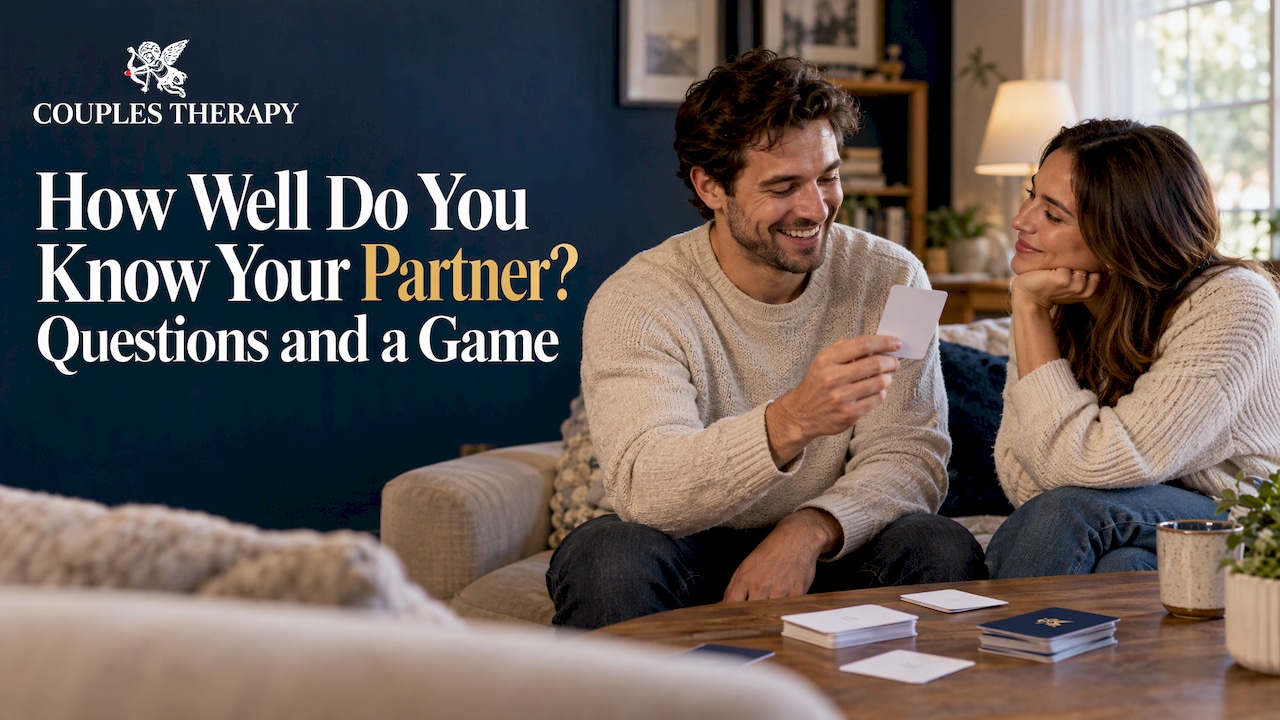
Here is the fun way to find out: skip the quiz about yourself and guess your partner’s answers instead. You write down what you think they’d say, they reveal the truth, and the gap is your score. Couples Therapy, the card game, is built on that idea, with 200 questions that run from lighthearted to deep, a date night mode for two, and a Couples vs Couples mode for a table full of friends. Below you’ll find sample questions, scoring rules you can use tonight with pen and paper, and ideas for dinner parties and game nights.
Quick note: this is a game. It’s for laughs, debates over who really knows who, and the occasional “wait, since when do you like that?”
TL;DR
- Guessing your partner’s answers is more fun (and more surprising) than answering questions about yourself.
- Start light: favorites, quirks and small stories. Move deeper only when the mood is right.
- Keep score simply: a correct guess earns points, a miss earns a laugh, and your partner is the judge.
- You can play as two on date night, or as couples against couples on one scoreboard.
- Couples Therapy, the card game, launches on Kickstarter in January 2027, and you can reserve a spot for $1 now.
Table of Contents
- Why guessing beats answering
- Ten light questions to try tonight
- A scoring system with real history
- Going deeper without getting heavy
- Date night for two
- Couples vs Couples: the dinner party version
- What’s in the box, and how to reserve
- Keep the game a game
- FAQ
- Sources
Why guessing beats answering
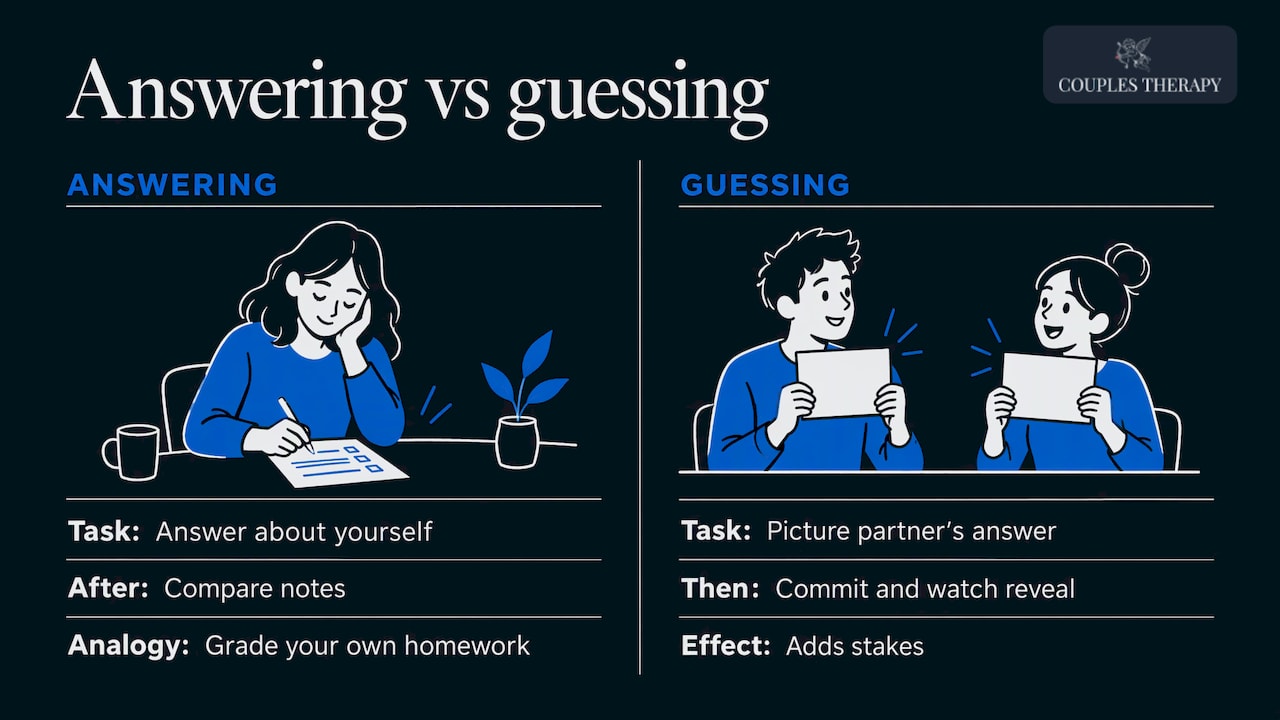
Most “how well do you know your partner” quizzes ask you to answer questions about yourself and then compare notes. It works, but it’s a bit like grading your own homework. Guessing adds stakes. You have to picture the other person’s answer, commit to it, and then watch their face while they reveal it.
There’s a nice side effect, too. Clinical psychologist Ramani Durvasula told Women’s Health that we only know what we’re told or what we think to ask, so even small facts, like a favorite animal, can go undiscovered for years. A guessing game is a cheap excuse to ask.
The format has deep roots in American living rooms, by the way. The TV show The Newlywed Game, hosted by Bob Eubanks, premiered in 1966 and stopped airing in 1974, and its spouse-guesses-spouse setup still turns up at showers and parties.
Ten light questions to try tonight
These are sample questions in the spirit of the card game’s Favourites, Traits and Experiences categories. Each person writes a guess for the other, then you reveal together.
- What’s my go-to comfort meal after a rough day?
- Which song will I sing loudly in the car even though I don’t know the words?
- What’s my most-used emoji?
- Would I rather have a lazy beach day or a packed city weekend?
- What’s the one thing I always forget when we travel?
- Which of my habits secretly drives you a little bit nuts, in a lovable way?
- What was my first job?
- If I won a free weekend anywhere, where would I send us?
- What’s the snack I’d defend in a fight?
- What’s my most embarrassing childhood memory that I’m willing to share?
Play it with a drink in hand and keep the energy up. If a guess is wildly wrong, that’s the best part of the night, not a verdict on anything.
How to score it
Keep it simple. A correct guess earns a point, and your partner is the judge. That matches how a Psychology Today quiz by Alice Boyes, PhD, has the partner decide whether you earn a point for each answer. For “close but not quite” answers, agree on a half point before you start, so nobody argues mid-round.
A scoring system with real history
If you want a proper structure, there’s a classic one in John Gottman’s book The Seven Principles for Making Marriage Work (1999). His Love Map 20 Questions Game gives you a list of 60 questions, and each partner picks twenty numbers at random and asks the matching questions. A correct answer earns the points shown beside that question, from 1 to 5, and the asker earns 1 point. The higher score after all twenty questions wins. Sample questions in the book run from naming your partner’s two closest friends (2 points) to describing their fondest unrealized dream (5 points). The game is meant to be played with laughter and gentle fun.
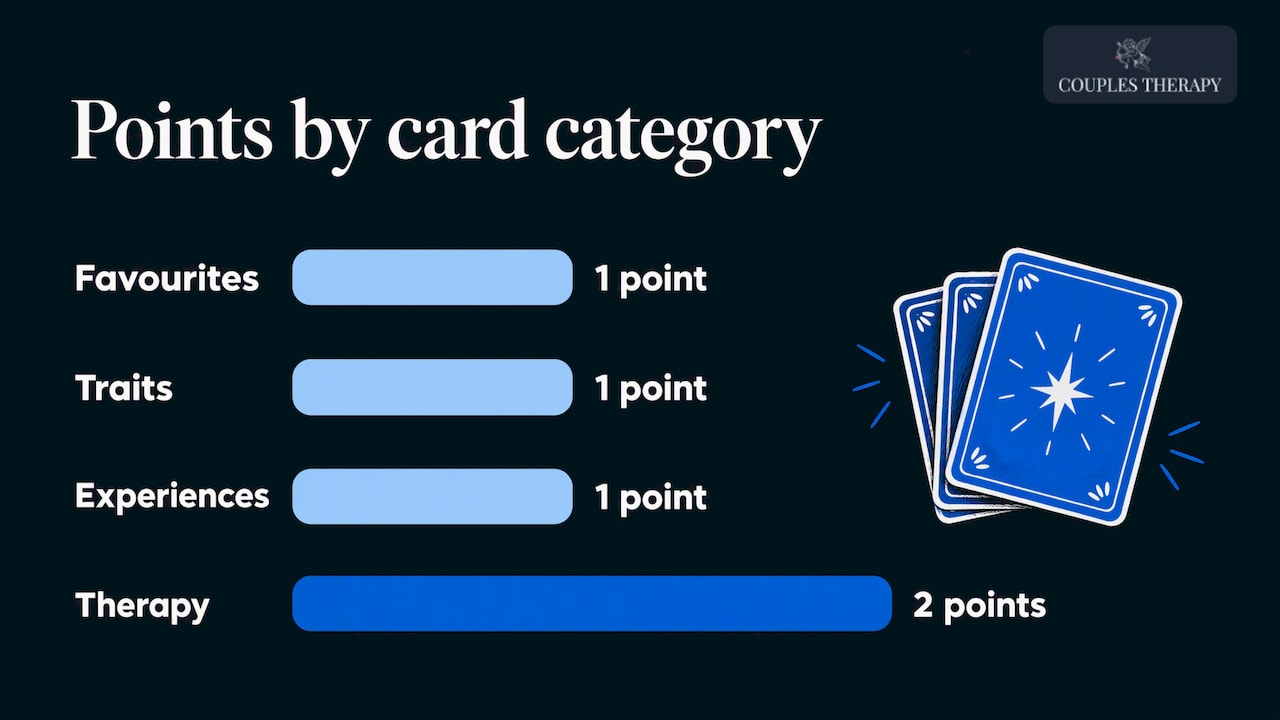
Two takeaways worth borrowing: harder questions deserve more points, and the asker should get a point too, so asking feels like part of the game and not an interrogation. Couples Therapy, the card game, uses the same logic in its own way: Favourites, Traits and Experiences cards are worth 1 point each, and the Therapy category, a playful deck name for the deeper questions, is worth 2.
Going deeper without getting heavy
Once you’ve warmed up, mix in questions about values, memories and dreams. Psychology Today’s 21-question quiz mixes in fears and childhood on purpose, along with lighter fun ones, because close couples tend to understand each other’s formative experiences and positive conversations matter too. The same article notes those questions suit relationships of several years or more.
A few deeper sample questions:
- What’s a risk I’m glad I took?
- What’s something I’ve changed my mind about in the last few years?
- What do I want our life to look like in five years?
- Which compliment do I remember best?
If a question leads to a longer conversation, great, let it. Talking about wishes and preferences openly is its own skill, and this guide to talking with a partner about your wishes offers a step-by-step approach if you’d like to carry a good game night into everyday conversation.
House rules that keep it fun
- Pass is always allowed. Durvasula advises respecting boundaries if someone isn’t comfortable answering.
- Play it as a game night, not in the middle of a disagreement.
- Draw a card or pick a question you both agree to. Nobody should feel ambushed.
- Stop when the laughing stops. Thirty to 60 minutes is plenty.
Want more ideas for conversation-style play? Our guide to conversation games for couples and our list of couples communication activities that feel like play cover formats beyond question cards.
Date night for two
Two players, one deck, no prep. Here’s how a night can run in Couples Therapy, the card game:
- Draw a card and read the question out loud.
- Each of you privately writes or decides what you think the other will answer.
- Reveal and compare.
- Score the points: 1 for Favourites, Traits and Experiences, 2 for Therapy.
- Swap, and keep going until you’ve had enough.
The 200 questions are arranged so a session can start breezy and drift deeper. A full game takes 30 to 60 minutes, which suits a dinner-at-home evening, a rainy afternoon, or the hour after the kids are asleep. For more plans to pair it with, browse fun date night ideas and rainy day date ideas.
Couples vs Couples: the dinner party version
This is where the guessing format shines. In Couples vs Couples mode, up to four couples share one scoreboard, so the game supports 2 to 8 players. Everyone at the table has an opinion about who’s going to win, and that’s half the fun.
Some hosting tips:
- Seat partners next to each other so reveals are easy to see.
- Keep the first round light so quieter guests warm up.
- Let the table heckle gently. A confident wrong guess is the best entertainment of the night.
- Mix couples of every kind. The questions work for any pairing, whether you’re newly dating or decades in, and for friends who just want to see who knows whom.
If you’re planning a double date, our roundup of games for double dates has more picks for four. And if your partner lives far away, there are long distance couple games that still feel like date night.
Running a Newlywed-style round at a party
Want a DIY version for a shower or reception? The classic setup has one partner answer out of earshot, the other guess, and every match scores 5 points, as in the 1966 show. Pick 8 to 12 questions the couple might disagree on, open with something funny, and close on a sweet one. Get both partners to approve every question ahead of time so nothing lands badly.
What’s in the box, and how to reserve
Couples Therapy, the card game, was created by Kara and Nik. It has 200 questions in four categories: Favourites, Traits, Experiences and Therapy. Players guess their partner’s answers, compare, and score points. You can play date night for two, or Couples vs Couples with up to four couples on one scoreboard. It’s a physical card game, so it goes on the table, not on a screen, and it makes a good gift for the couple who has everything or for friends who love a game night.
The First Edition is limited to 1,000 copies and launches on Kickstarter in January 2027. It ships to North America. A $1 reservation holds your spot, and the $1 is refunded at launch. It isn’t a purchase of the game.

Ready to hold a spot? Reserve for $1 and you’ll be set for the January 2027 launch.
Keep the game a game
The best “how well do you know your partner” nights end with a story, not a final score. A few ways to make that more likely:
- Ask follow-ups. “Why did you think I’d say that?” is where the good stuff lives.
- Keep a running list of surprises. Many couples find the oddest answers become inside jokes.
- Celebrate misses. Nobody ever laughed harder at a correct guess.
- Play again in a few months. Tastes, plans and favorite snacks change, so the same question can earn a new answer.
FAQ
How do you play a “how well do you know your partner” game?
Each person guesses how the other would answer a question, then you reveal the real answers and award points for matches. Decide ahead of time who judges close calls, and how many points each question is worth. Couples Therapy, the card game, handles this with 1 point for most cards and 2 for the deeper Therapy category.
What are good questions to ask your partner to see how well you know them?
Start with favorites, habits and small stories, like a comfort meal, a car song or a first job. Then move to memories, values and future plans. Mixing light and deep questions keeps the game fun and gives you something to talk about afterward.
How long does a game like this take?
A session of Couples Therapy, the card game, runs 30 to 60 minutes. Aron’s well-known 36 questions are described as taking about 45 minutes, so that’s a fair benchmark for an evening of question-based play.
Can more than two people play?
Yes. Couples vs Couples mode lets up to four couples play on one scoreboard, so the game works for 2 to 8 players. It’s a natural fit for dinner parties and game nights with friends.
Is the $1 reservation a purchase?
No. The $1 reservation holds your spot for the Kickstarter launch in January 2027 and is refunded at launch. The game itself is bought during the campaign.
Sources
- Couples Quiz: How Well Do You Know Your Partner? (Women’s Health)
- 21 Questions to Test How Well You Really Know Your Partner (Psychology Today)
- 36 Questions to Bring You Closer Together (Psychology Today)
- The Love Map 20 Questions Game, from The Seven Principles for Making Marriage Work (Gottman)
- 45 Best Newlywed Game Questions (BuzzFeed)
- 5 Schritte: Wie du mit deinem Partner über deine Wünsche sprichst