
Blog
Couples Communication Activities That Feel Like Play
The best couples communication activities are the ones you will actually do twice. That usually means short, a little silly, and built so nobody has to perform. Below you will find a listening round, a weekly check-in, a gratitude swap and a guessing game, plus ways to scale them up for a table of friends. Our own pick is a guessing game: in Couples Therapy, the card game, you guess your partner’s answers instead of answering about yourself, and the talking happens on its own. To be clear, it is a game. It is for a fun night, not a stand-in for anything clinical.
TL;DR
- Structure is what makes these activities work: turns, a timer, and one job at a time (speak or listen).
- Start with low-stakes topics. Favorite meals beat the budget as a warm-up.
- Playfulness counts. A 2019 study of over 200 couples linked a playful style to relationship happiness and admiration of the partner.
- Guessing games turn listening into a score: you only win by paying attention to each other.
- Couples Therapy, the card game, has two ways to play: date night for two, and Couples vs Couples with up to four couples on one scoreboard.
Table of Contents
- Why structure beats “let’s just talk more”
- Activity 1: The speaker and listener round
- Activity 2: The soft start
- Activity 3: The weekly check-in
- Activity 4: The gratitude swap
- Activity 5: The guessing game
- How to pick the right activity for tonight
- Taking it to a dinner party or game night
- Making any of these work better
- Where Couples Therapy, the card game fits
- FAQ
- Sources
Why structure beats “let’s just talk more”
Most of us communicate fine about logistics and badly about everything else, mostly because “let’s talk” has no shape. Who goes first? How long? What counts as done? Every activity below answers those questions in advance, which is why they feel easier than a free-form chat.
There is also a mood factor. Researchers who study play found that couples who clown around together tend to report more tenderness and more belief that the relationship will last, according to the Greater Good Science Center’s summary of the Proyer study. You do not need a serious topic to practice paying attention to each other. A silly one works, and often works better.
A note on scope: these are everyday activities for couples who are doing fine and want to enjoy each other more. If a conversation tends to blow up, a licensed couples therapist is the right person to see, and a card game is not the answer.
Activity 1: The speaker and listener round
This is the classic, and it is simple enough to run on the couch.
- Pick a low-stakes topic. A weekend plan, a movie you disagreed about, the best meal you had this month.
- Set a timer for three to five minutes. Mason Family Counseling suggests that range in its at-home speaker-listener guide.
- The speaker talks in “I” statements. “I loved how relaxed Saturday felt” rather than “You never plan anything.”
- The listener does not interrupt, defend or fix. Their only job is to take it in.
- The listener summarizes what they heard, then asks if they got it right. The speaker corrects anything that was missed.
- Switch roles.
Where it goes wrong: the listener starts drafting a rebuttal while you are still talking, or the speaker turns a light topic into a list of grievances. A physical object helps. Hand over a pen or a coaster as the “floor” and whoever holds it talks, a trick described in ICANotes’ overview of the speaker-listener technique.
Expect it to feel a bit stagey the first time. That is normal, and it fades once you have done a few rounds.
Activity 2: The soft start
How a conversation begins tends to set how it ends. Utah State University Extension recommends softening the startup with “I” statements instead of “You” accusations. Kaiser Permanente’s 2023 couples communication handout gives a handy three-part formula: your feeling in one word, the factual situation, and a positive request.
Try it on something tiny, in a playful spirit:
- “I feel hungry because it’s 8 p.m. and we haven’t picked dinner. Could we choose by 8:15?”
- “I feel excited because the weekend is close. Can we plan one thing to look forward to?”
Practicing on pizza makes the formula automatic, so it is there when the topic is bigger. If either of you ever feels worked up mid-conversation, taking a break of at least 20 minutes to calm down is the advice from the same USU Extension page. Either of you can call it, no explanation needed.
Activity 3: The weekly check-in
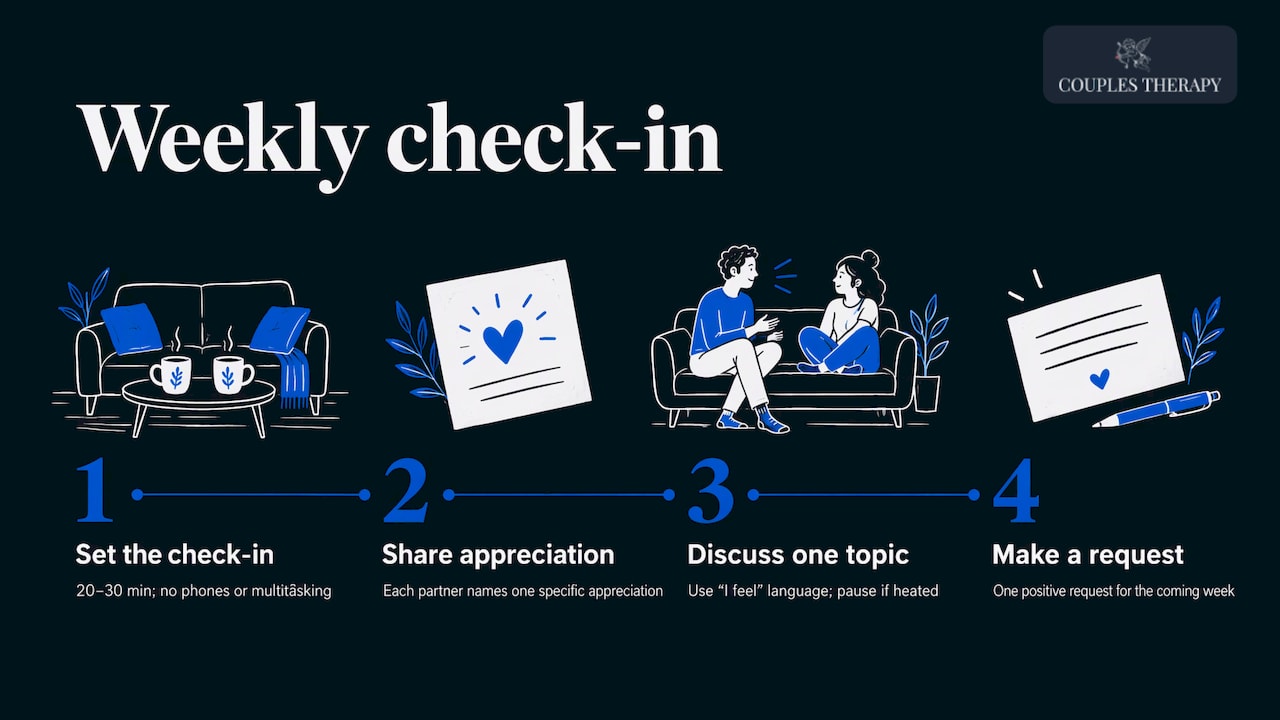
A standing date with each other beats an emergency talk every time. ICANotes describes a weekly check-in of 20 to 30 minutes: each partner opens with one specific appreciation, you discuss one thing using “I feel” language, and you end with one positive request for the coming week. The ground rules are no phones, no multitasking, and a pause if things heat up.
Wellspring Counselling’s check-in routine adds a nice touch: each of you rates your sense of connection out of 10, and then you simply compare numbers. A 6 and an 8 is a perfectly good conversation starter.
Make it pleasant on purpose. Same day, same drink, same couch. Check-ins stick when you look forward to them.
Activity 4: The gratitude swap
The lowest-effort habit on this list. Each of you names three specific things the other did recently that you appreciated, then says thank you. Specific is the whole trick: “thanks for handling dinner” is nice, but “thanks for texting me a photo of the soup you were making because it made my afternoon” lands.
Do it after supper or before bed. Keep a jar if you like paper, a shared note if you don’t. It takes five minutes and it shifts what you notice during the day, because you start looking for things to thank each other for.
Activity 5: The guessing game
Every exercise above asks you to say how you feel. This one flips the job: you guess how your partner would answer. That small change does a lot of work.
When you answer about yourself, you are talking. When you predict your partner’s answer, you are using everything you have noticed about them, and then you find out how well it matched. The reveal is where the conversation starts. “Wait, that’s your favorite?” is a better opener than any prompt we could write.
This is how Couples Therapy, the card game works. There are 200 questions in four categories:
| Category | Points | What it feels like |
|---|---|---|
| Favourites | 1 | Light and quick: foods, songs, comfort movies |
| Traits | 1 | How you each come across, and how you see yourselves |
| Experiences | 1 | Memories, firsts, and stories you may or may not have told |
| Therapy | 2 | Our playful name for the deeper questions, worth double |
The “Therapy” label is just a deck name for the questions that go a little deeper. It is a card category, not a clinical anything. A session runs 30 to 60 minutes, which fits an evening without taking it over.
Two ways to play
Date night for two. You trade turns guessing and scoring. Start with a few Favourites cards to warm up, and let the 2-point Therapy cards show up once you are both loose. A Favourites card might ask for your partner’s go-to takeout order. Easy points, big laughs when you are wrong. A deeper card might ask about a moment your partner would call a turning point. Those answers tend to start the longer talks.
Couples vs Couples. Up to four couples share one scoreboard, so the game works for 2 to 8 players. Each couple is a team, which keeps the energy playful rather than personal. We have more on date formats in our guide to conversation games for couples.
How to pick the right activity for tonight
Women’s Health talked to relationship experts about couples games, and the advice was to decide your goal first: more playfulness, deeper conversation, or simply a good time. Then choose something that suits both of you, with a length that fits the time you have. Here is a quick way to apply that:
| Your evening | Try this |
|---|---|
| 10 minutes, tired | Gratitude swap |
| 20 to 30 minutes, calm Sunday | Weekly check-in |
| 5 minutes, practicing a new habit | Soft start on a tiny topic |
| 30 to 60 minutes, you want to laugh | Guessing game for two |
| A table of friends | Couples vs Couples |
If your partner groans at anything that sounds like homework, go straight to the guessing game. It has a score, which gives the evening a reason to exist beyond “improving communication.”
Taking it to a dinner party or game night
Communication activities can get awkward in a group, because the vulnerable ones are meant for two. The fix is to pick formats where the group is laughing at how wrong the guesses are, not at anyone’s feelings.
- Make couples the teams. Everyone gets a partner to protect them. A wrong guess is a team story, not an exposure.
- Start light. Open with Favourites-style questions. Save the deeper ones for when the wine and the mood have settled in.
- Let the table react. Half the fun of a couples scoreboard is watching someone confidently guess wrong about the person they live with.
- Keep it short. Aim for 30 to 60 minutes so there is still time for dessert and ordinary conversation.
- Keep it kind. Any couple can pass on a card that feels too personal for the room. It is a game, and the point is a fun night.
For more ideas on filling an evening with friends, this roundup of game night games to play is a good place to browse. If you are planning something for just the two of you, our date night ideas cover plans at home and out.
Making any of these work better
A few habits apply to everything above:
- Keep the stakes low. Practice on movies, meals and weekend plans, not on the biggest disagreement you have.
- Name the format. “Want to do the five-minute listening thing?” is easier to say yes to than “we need to talk.”
- Protect the time. No phones. A single interruption can sink a short activity.
- Stop while it is fun. Ending an activity wanting more is how a habit forms.
- Pause when you need to. If either of you feels tense, stop and come back later. Nobody has to finish a round.
Where Couples Therapy, the card game fits
If you want a ready-made evening instead of inventing prompts, Couples Therapy, the card game, gives you 200 questions, a scoreboard and two ways to play: date night for two, or Couples vs Couples. It is a physical card game for 2 to 8 players, and it makes a good gift for the couple who has everything.
The First Edition is limited to 1,000 copies and launches on Kickstarter in January 2027, shipping to North America. A $1 reservation holds your spot and is refunded at launch.

Reserve for $1 and we will let you know when the campaign opens.
FAQ
What are good communication activities for couples who are doing fine?
Short, structured and playful ones: a speaker and listener round on a light topic, a weekly check-in, a gratitude swap, or a guessing game like Couples Therapy, the card game. They work as habits, not as fixes.
How long should a couples communication exercise take?
Most take 5 to 30 minutes. The speaker-listener round runs about three to five minutes per turn, and a weekly check-in runs 20 to 30 minutes. A session of our card game takes 30 to 60 minutes.
Can we do these activities with other couples?
Yes, if you choose group-friendly formats. Couples vs Couples lets up to four couples play on one scoreboard, which keeps the mood playful. Open with light questions and let anyone pass on a card.
Is Couples Therapy a real therapy tool?
No. Couples Therapy, the card game, is a physical card game for a fun night with your partner or with friends. The “Therapy” category is just our name for the deeper, 2-point questions in the deck.
Sources
- What Playfulness Can Do for Your Relationship, Greater Good Science Center
- Effective Communication Skills: Resolving Conflicts, Utah State University Extension
- Couples Communication: Participant Handout, Kaiser Permanente (2023)
- 12 Effective Couples Therapy Activities for Stronger Relationships, ICANotes (2026)
- Couples Counseling: Communication Exercises, Mason Family Counseling
- Relationship Check-In Tool, Wellspring Counselling
- 19 Fun Games For Couples, According To Relationship Experts, Women’s Health (2025)